BMI Calculator WHO Standard
Evaluate your Body Mass Index (BMI), dynamic health classification, and healthy target weight range according to World Health Organization clinical standards.
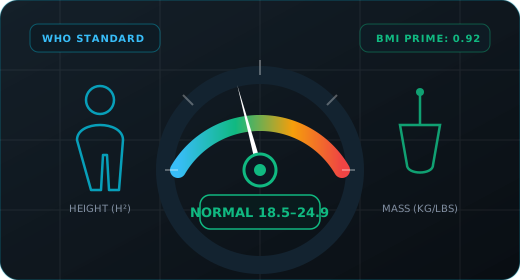
WHO Body Mass Index Classification
| Category | BMI Range (kg/m²) |
|---|---|
| Severe Thinness | < 16.0 |
| Moderate Thinness | 16.0 – 16.9 |
| Mild Thinness | 17.0 – 18.4 |
| Normal Weight | 18.5 – 24.9 |
| Overweight (Pre-obese) | 25.0 – 29.9 |
| Obese Class I (Moderate) | 30.0 – 34.9 |
| Obese Class II (Severe) | 35.0 – 39.9 |
| Obese Class III (Very Severe) | ≥ 40.0 |
What is Body Mass Index (BMI)?
Body Mass Index (BMI) is an internationally recognized anthropometric metric that assesses whether an individual's weight is proportionate to their height. Devised in the 19th century by Belgian polymath Adolphe Quetelet, BMI provides a rapid, non-invasive clinical screening tool to categorize individuals into underweight, normal, overweight, and obese classifications.
How is BMI Calculated?
BMI = weight (kg) ÷ [height (m)]²
US Imperial Formula:
BMI = 703 × weight (lbs) ÷ [height (inches)]²
What is BMI Prime?
BMI Prime is a simple normalization ratio defined as BMI ÷ 25 (the upper
threshold of healthy normal weight).
A BMI Prime below 0.74 represents underweight, 0.74 to 0.99 represents healthy normal weight, and 1.00 or
higher represents overweight or obese status. Because it is a ratio, BMI Prime allows intuitive assessment
of how close someone is to their clinical upper healthy threshold.
Limitations of BMI: Why It Doesn't Tell the Whole Story
While BMI is a valuable epidemiological benchmark, it has recognized physiological limitations when applied to individuals:
- Muscle Density: Dense skeletal muscle weighs significantly more by volume than adipose fat. Bodybuilders and strength athletes often register as "overweight" or "obese" despite having single-digit body fat percentages.
- Fat Distribution: BMI does not distinguish between visceral abdominal fat (which carries elevated cardiovascular risks) and subcutaneous fat.
- Age & Bone Density: Older adults naturally lose muscle mass and bone mineral density, meaning a normal BMI might mask sarcopenic obesity.
For a more granular body composition assessment, combine your BMI with our Body Fat Percentage Calculator.